
I plan event-based reefer loads around three things: product temperature, venue access, and total time committed. Before accepting a load, I confirm the shipper’s written setpoint, gate instructions, unloading plan, and extra charges – not just the mileage.
My planning covers:
- Timing: Fit driving, rest, staging, and unloading within legal hours. Standard federal limits allow up to 11 hours of driving within a 14-hour window after 10 consecutive hours off duty.
- Costs: Count all miles, reefer fuel, waiting, labor, storage, and returns.
- Cold-chain care: Check trailer sanitation, pre-cooling, airflow, fuel, and monitoring. Trailer-air readings alone don’t prove product temperature.
- Problems and paperwork: Get written instructions for delays, rejected freight, and storage changes. Keep temperature logs, charge approvals, and signed delivery records.
My rule: <u>confirm the plan and payment terms before committing the truck.</u>
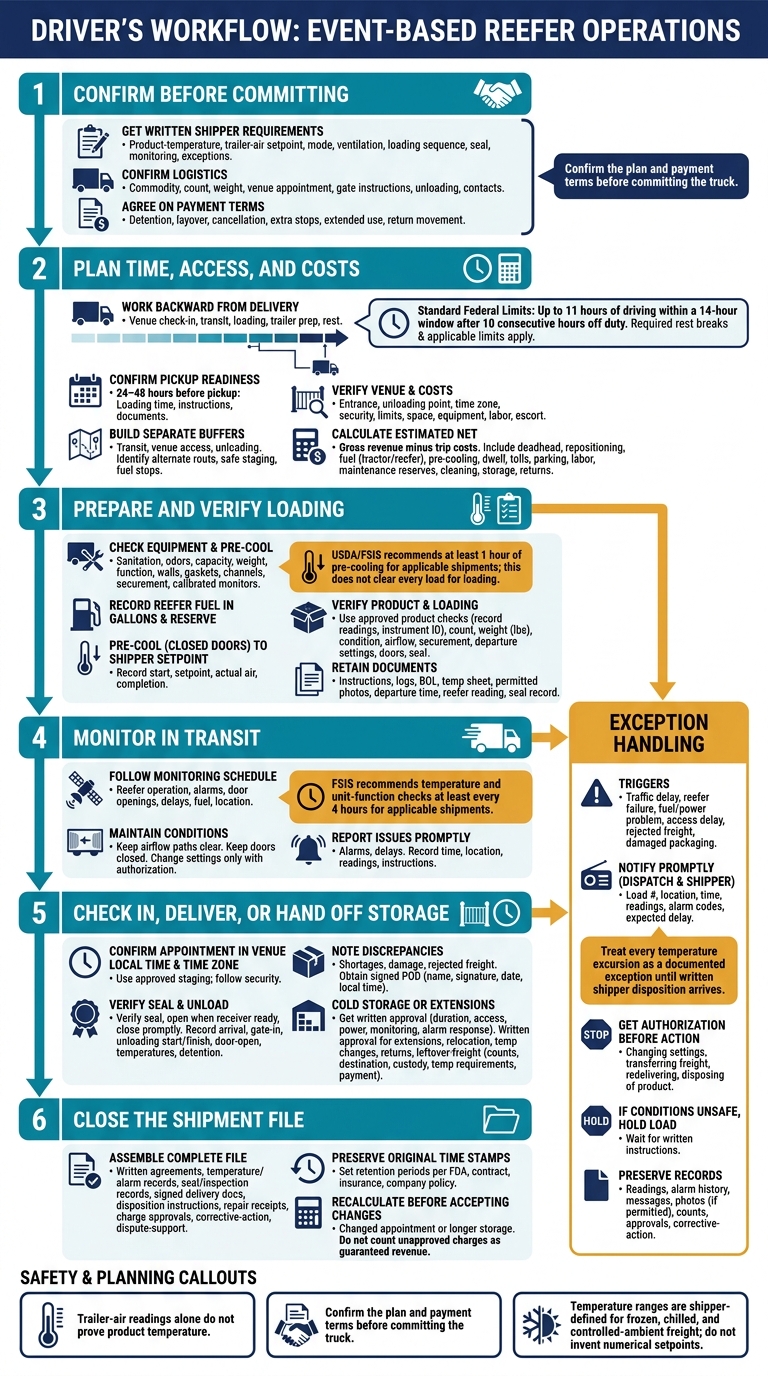
Event-Based Reefer Logistics: Booking to Payment
Plan the Load and Estimate Profit
Work Backward From the Delivery Appointment
Once you book the load, plan the trip around the check-in time. Work backward through transit, loading, trailer preparation, rest, and venue access.
For property-carrying drivers, standard federal limits allow up to 11 hours of driving within a 14-hour on-duty window after 10 consecutive hours off duty. Required rest breaks and applicable weekly limits also apply.
Build separate buffers for transit, venue access, and unloading. Check the route for heat, wind, storms, icy grades, and closures. Record an alternate route, a safe staging location, and a fuel stop. Don’t count on an adverse-driving-conditions extension being available.
| Milestone | Deadline | Written confirmation |
|---|---|---|
| Booking | Before acceptance | Written load brief and rate confirmation |
| Route review | Before acceptance | Route, rest stops, weather buffer, and parking |
| Pickup readiness | 24–48 hours before pickup | Loading time, complete instructions, and documents |
| Trailer preparation and loading | Before departure | Setpoint, loading completion, and departure time |
| Transit | Throughout trip | ETA changes and escalation contacts |
| Gate check-in and unloading | At confirmed venue times | Check-in, unloading, and release times |
| Post-delivery | After unloading or storage ends | Trailer release, returns, and billing documents |
Use this timeline to spot delays before they cut into the appointment window.
Confirm Venue Access and Load Instructions
Ask for the freight entrance, gate, unloading point, time zone, security rules, truck limits, backing space, equipment and labor needs, and on-site contact. Confirm the appointment time and whether you’ll need an escort.
Get approval for early-arrival parking, plus written handling and return instructions. If parking isn’t available, arrange off-site staging before dispatch.
If the trailer will serve as cold storage, get separate written approval for that use. Extensions, relocation, and temperature changes also need written approval. Spell out the storage duration, release time, placement, access, power responsibility, monitoring frequency, and alarm response. Confirm who will keep the refrigeration running if the driver leaves.
Calculate Costs and Agree on Extra Charges
Once access and timing are set, price the added time and handling before accepting the load.
Calculate gross revenue minus trip costs, using total miles – not just loaded miles. Include deadhead and repositioning, tractor and reefer fuel, pre-cooling and dwell time, tolls, parking, unloading labor, maintenance reserves, cleaning, storage, and return movement.
Calculate revenue per total mile and per committed hour. Estimated trip earnings aren’t business profit until you account for fixed expenses and taxes.
Put dollar amounts or calculation methods in the rate confirmation for detention, layover, cancellation, extra stops, extended trailer use, and return movement. Define detention’s free hours, start trigger, hourly rate, and required proof.
Assign responsibility for parking, unloading, storage fuel or power, and emergency repositioning. Recalculate before accepting a changed appointment or longer storage period. Don’t count unapproved charges as guaranteed revenue.
sbb-itb-e2527cf
Prepare the Trailer and Deliver the Load
Once the route and access plan are set, prepare the trailer and put load controls in place.
Match Equipment to the Freight
Follow the shipper’s written requirements for product temperature, trailer-air setpoint, ventilation, loading sequence, seal procedure, monitoring, and exceptions.
| Freight category | Temperature requirement | Equipment setup | Monitoring method | Main risk |
|---|---|---|---|---|
| Frozen | Shipper-defined range | Check cooling capacity, reefer mode, fuel, and pallet airflow | Reefer records and approved product checks | Thawing, refreezing, or hidden temperature damage |
| Chilled | Shipper-defined range | Pre-cool, maintain airflow, and limit warm-dock exposure | Logger or reefer records and approved product checks | Warming, condensation, microbial growth, or rejection |
| Controlled ambient | Shipper-defined range | Confirm cooling or insulation needs; use ventilation only if specified | Agreed ambient or product readings | Heat or cold exposure, condensation, or odor transfer |
Check usable capacity, weight limit, refrigeration function, cleanliness, odors, floor channels, walls, gaskets, securement gear, and calibrated monitors. Make sure recording functions work. Record reefer fuel in gallons, then plan fuel stops around route miles, waiting time, detours, and delivery-site delays. Include a fuel reserve.
With the right trailer in place, establish temperature control before moving the first pallet.
Check Loading and Monitor the Load
Pre-cool with the doors closed to the shipper-required setpoint. Record the start time, setpoint, actual air reading, and completion time. USDA/FSIS guidance recommends at least 1 hour of pre-cooling for applicable shipments, but that does not clear every load for loading.
Use the shipper-approved product-check method. Trailer-air readings do not prove product temperature. Shipper-approved personnel should record readings and instrument identification without damaging packaging.
| Stage | Verification | Responsible party | Record retained |
|---|---|---|---|
| Before loading | Instructions, sanitation, capacity, fuel, pre-cooling, and recorder operation | Shipper supplies requirements; carrier checks equipment; loader verifies preparation | Instructions, inspection, pre-cool log |
| Loading | Product checks, counts, weight in pounds, condition, airflow, and securement | Shipper/loader and driver within assigned duties | BOL, temperature sheet, permitted photos |
| Departure | Setpoint, reefer mode, ventilation, doors, and seal match instructions | Driver | Departure time, reefer reading, seal record |
| Transit | Reefer operation, alarms, door openings, delays, fuel, and location | Driver/carrier | Temperature data, alarm log, dispatch messages |
| Delivery | Seal, unloading times, temperatures, shortages, and damage | Receiver and driver | Delivery notes, temperature record, signed POD |
Keep evaporator outlets, floor channels, and return-air paths clear. Secure pallets so they cannot shift.
Follow the agreed monitoring schedule. FSIS guidance recommends temperature and unit-function checks at least every 4 hours for applicable shipments. Report alarms or delays promptly, and record the time, location, readings, and instructions received. Keep doors closed, and change settings only with authorization.
At arrival, move from transit checks to venue check-in and delivery records.
Check In and Record Delivery
Call the venue contact before arrival and confirm the appointment in venue local time and time zone. Follow gate and security instructions, park only in approved safe areas, and verify the seal before opening. Open the doors when the receiver is ready, then close them promptly.
Get written approval for returns, leftover freight, or cold-storage handoffs. Include counts, destination, custody transfer, temperature requirements, and payment responsibility.
Record arrival, gate-in, unloading start and finish, door-open time, temperature readings, and detention times. Note shortages, damage, and rejected freight on the receipt. Obtain a POD with the receiver’s name, signature, date, and local time.
Manage Food Safety, Load Problems, and Records
Follow Sanitation and Food-Safety Rules
After pickup and throughout transit, written rules – not memory – guide cold-chain handling.
The FDA FSMA Sanitary Transportation Rule may apply to event food loads, whether they cross state lines or stay within one state. Check for exemptions before pickup. If the load’s status is unclear, get written guidance from the shipper or a qualified food-safety professional.
Review written agreements and shipper instructions so everyone knows their sanitary-transportation duties. If the carrier accepts responsibility for sanitary conditions during transit, it must give relevant personnel appropriate food-safety training and keep the required procedures and records. Follow those instructions and keep equipment sanitary.
Use the shipper’s validated product criteria and approved measurement method. Trailer-air readings alone do not prove product temperature. When authorized, use a calibrated thermometer or recorder to log air and product readings. Include the time, location, and device information.
Respond to Delays, Breakdowns, and Rejected Loads
Treat every temperature excursion as a documented exception until the shipper provides written disposition. Promptly send dispatch and the shipper the load number, location, time, readings, alarm codes, and expected delay.
Get authorization before changing settings, transferring freight, redelivering, or disposing of product. If conditions may have made the food unsafe, hold the load and wait for written instructions.
| Problem | Immediate action | Notify | Records to preserve |
|---|---|---|---|
| Traffic delay | Keep doors closed, maintain approved reefer operation, and request instructions | Dispatch, shipper, receiver | Delay times, location, temperature log, messages, charge approval |
| Reefer failure | Safely check alarms, fuel, power, airflow, and doors; request service | Dispatch, shipper, repair provider | Alarm history, setpoint, readings, diagnosis, photos, instructions |
| Fuel or power problem | Safely refuel or connect approved power. Do not change the setpoint without authorization. | Dispatch, shipper, venue contact | Outage duration, reefer status, temperatures, receipts, corrective action |
| Venue access delay | Remain sealed when possible and request staging instructions | Receiver, event contact, dispatch | Gate times, contact names, seal status, messages |
| Rejected freight | Keep custody until written disposition arrives; get the rejection reason in writing | Receiver, shipper, dispatch, broker or insurer as applicable | Exception notation, photos, temperatures, counts, approvals |
| Damaged packaging | Protect affected cases without unnecessarily disturbing the load; request evaluation | Shipper, receiver, dispatch | Package and pallet photos, case count, seal details, inspection notes |
Keep Load and Payment Records
Close each load with one complete shipment file to support payment and any claim. Include written agreements, disposition instructions, repair receipts, charge approvals, the corrective-action report, and dispute-support documents.
Preserve original time stamps. Set retention periods by record type, following applicable FDA requirements, contract and insurance terms, and company policy. Keep required procedures and training records retrievable. A complete file helps speed payment and protect your detention, rejection, or damage claim.
Conclusion: Prepare for Your Next Event Load
Accept the load only when the freight, equipment, route, and appointment match. Get written approval for detention, extra stops, and special handling before you commit.
Owner-Operator Support From Booker Transportation Services
Booker Transportation Services is a 100% owner-operator carrier specializing in refrigerated and frozen freight, primarily in Texas, Oklahoma, Kansas, Nebraska, Colorado, and New Mexico. It offers leasing options, daily pay, longevity bonuses, and a free tires program for qualified drivers. Confirm event-load availability, eligibility, and terms before booking.
Final Load Readiness Checklist
Use this checklist to verify readiness before dispatch, then check it again at delivery:
- Instructions: Get written confirmation of the commodity, count, weight, setpoint, operating mode, and monitoring requirements.
- Equipment: Check sanitation, trailer condition, doors, seals, drains, fuel, settings, alarms, and pre-cooling.
- Temperature: Arrange approved product-temperature checks. Keep time-stamped records of temperatures, alarms, seals, and inspections.
- Schedule and access: Verify the appointment, entrance, staging area, unloading equipment, contacts, and route buffer time.
- Charges and returns: Agree in writing on detention, lumper fees, redelivery, storage, extra stops, and return instructions.
- Delivery: Get a signed proof of delivery (POD) showing arrival and departure times, delivered quantities, seal status, and any shortages, damage, or exceptions.
FAQs
How do I price multi-day event reefer loads?
Focus on total trip profit, not just the outbound linehaul rate. Add up linehaul pay, fuel surcharges, and accessorials such as detention, layover, and stop-off fees. Then subtract fixed and variable costs – including reefer diesel consumption of 0.5 to 1.0 gallons per hour.
Before accepting a load, factor in deadhead miles and potential reloads. A lower-paying load can leave you with more profit if it means fewer empty miles. Build in extra time for weather or traffic delays, too.
Does my cargo insurance cover on-site cold storage?
The provided documents don’t confirm whether cargo insurance covers on-site cold storage. Coverage depends on your policy’s terms and exclusions, so check the policy to see what’s covered. Pay close attention to weather-related exclusions and coverage gaps that could leave your business unprotected during logistics operations.
What if product temperatures differ from reefer readings?
Reefer air readings don’t always match your cargo’s internal (pulp) temperature. If the readings differ, check the product directly with a calibrated pulp thermometer. Sample 50% to 75% of pallets during loading and unloading. Record your findings with time-stamped photos to document compliance and help protect against claims.
If the reefer display and secondary thermometer differ by more than 1 to 2°F, recalibrate your sensors immediately.
Related Blog Posts
About Booker Transportation
Booker Trans is 100% Owner Operator. It is our belief that an Independent Owner is the best way to get a customers freight delivered timely and safely. Booker is a leading Refrigerated Carrier providing the best lease options in the industry for today’s Owner Operators. Monthly and Yearly Awards, Longevity Bonuses, and the Free tires for Life of Lease Program, are just a few examples of what Booker Trans offers the Owner Operator. Booker Trans has built it’s success upon working partnerships with Customers, as well as Agency Relationships built over the last 20 years. Those same relationships are what makes consistent year round freight possible.
Are you interested in becoming an owner operator driver or getting into the logistics industry?
Let’s connect!
How to Inspect Refrigerated Trailer Insulation
10/26/2026

IFTA Fuel Tax Basics for Owner-Operators
10/19/2026
