
Paying fuel tax at the pump doesn’t replace your quarterly IFTA return. I start by checking whether my truck qualifies and whether my lease assigns filing to me or my carrier.
IFTA covers 48 U.S. states and 10 Canadian provinces, dividing fuel taxes based on where you drive – not just where you buy fuel. Here’s what I check before filing:
- Calculations: Use fleet MPG and taxable miles to calculate fuel use, then apply quarterly rates and eligible tax-paid fuel credits.
- Records: Track miles by jurisdiction, save fuel receipts, and keep tractor and reefer fuel separate.
- Filing: Submit through the base jurisdiction every quarter, even with no activity, and correct errors with supporting records.
- Retention: Keep records for <u>at least four years</u> from the later of the return’s due date or filing date.
Before submitting, I confirm current rates, deadlines, exemptions, and record rules with my base jurisdiction.
WHAT IS IFTA AND WHY IS IT IMPORTANT?
sbb-itb-e2527cf
How to Calculate Quarterly IFTA Taxes
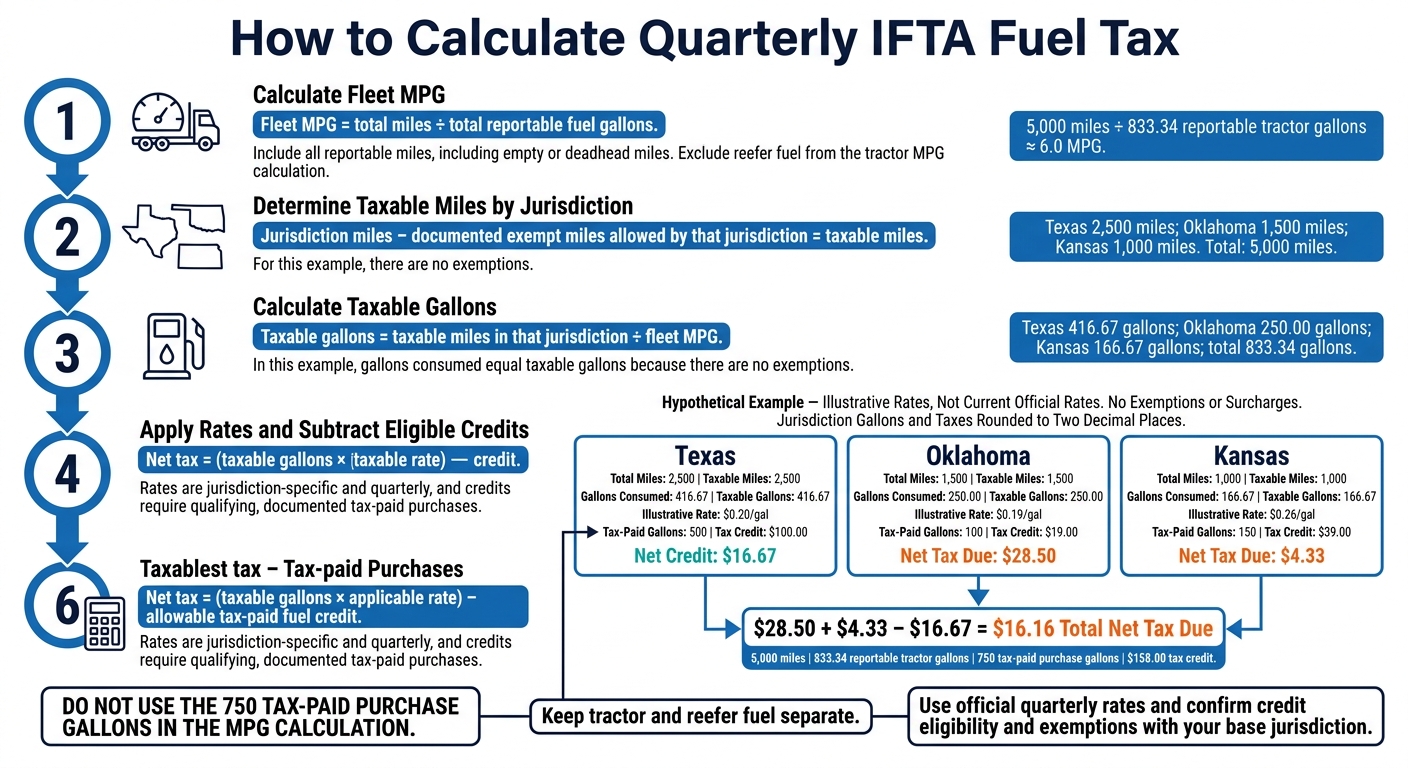
How to Calculate Quarterly IFTA Fuel Tax
Once you know who’s responsible for filing, quarterly IFTA reporting comes down to mileage, fuel, and credits.
Your return groups fleet miles and fuel by jurisdiction and fuel type to calculate a balance due or credit. Track tractor and reefer fuel separately. Reefer fuel doesn’t belong in the tractor MPG calculation.
Calculate Fleet MPG and Taxable Gallons
Fleet MPG = total miles ÷ total reportable fuel gallons. Include all reportable miles – even empty or deadhead miles – but exclude reefer fuel from the tractor calculation.
Track total miles for each jurisdiction, then subtract only documented exempt miles that jurisdiction allows. Use the remaining taxable miles to calculate fuel use:
Taxable gallons = taxable miles in that jurisdiction ÷ fleet MPG.
Apply Fuel Tax Rates and Credits
Net tax = (taxable gallons × applicable rate) − allowable tax-paid fuel credit.
Use each jurisdiction’s official quarterly rate. Claim credits only for documented tax-paid fuel purchases that qualify for credit in that jurisdiction.
Credits can offset balances in other jurisdictions. Credits carried forward can also offset later balances.
Example: Texas, Oklahoma, and Kansas IFTA Calculation
This hypothetical example shows the calculation across three jurisdictions using illustrative rates – not current official rates.
Assume 5,000 miles and 833.34 reportable tractor gallons consumed, giving approximately 6.0 MPG, with no exemptions or surcharges. The table uses illustrative rates and rounds jurisdiction gallons and taxes to two decimal places.
Jurisdiction Total miles Taxable miles Gallons consumed Taxable gallons Illustrative rate/gal Tax-paid gallons Tax credit Net tax due or credit Texas 2,500 2,500 416.67 416.67 $0.20 500 $100.00 ($16.67) Oklahoma 1,500 1,500 250.00 250.00 $0.19 100 $19.00 $28.50 Kansas 1,000 1,000 166.67 166.67 $0.26 150 $39.00 $4.33 Total 5,000 5,000 833.34 833.34 N/A 750 $158.00 $16.16
Do not use the 750 tax-paid purchase gallons in the MPG calculation.
Keep Mileage and Fuel Records for Tractor and Reefer Units
After calculating tax, support it with clear mileage and fuel records that document taxable miles, fuel credits, and jurisdiction splits.
Record Trips and Fuel Purchases
Keep trip sheets, odometer readings, and distance records where needed. Include:
- Date, origin, destination, and route: Enter these details on trip sheets.
- Beginning and ending odometer readings: Keep readings that support total trip miles.
- Total and jurisdiction miles: Save the state-by-state breakdown in trip sheets or electronic distance records.
- Unit ID and load status: Use bills of lading to document loaded trips and trip sheets to document empty, deadhead, and bobtail travel.
Fuel receipts should show the purchase date, seller’s name and location, gallons, price per gallon or total sale amount, purchaser’s name, and vehicle identifier. Also keep documentation of tax-paid status to support fuel credits.
Keep Tractor and Reefer Fuel Separate
For refrigerated fleets, keep propulsion fuel separate from reefer fuel. If you fuel both units at one stop, ask for separate receipt line items showing gallons and costs for each.
Assign every purchase to the tractor or reefer that received the fuel. Add any missing unit details at the time of purchase. File records by unit and reporting period, and identify the fuel type so reefer purchases stay out of propulsion totals and credits.
Check Records Monthly and Keep Audit Support
Each month, compare odometer readings with trip sheets and electronic distance records. Check jurisdiction-mile allocations, then verify exempt miles and fuel totals by unit and fuel type. Investigate unusual MPG changes before filing the quarterly return.
Keep records for at least four years from the later of the due date or filing date. Maintain electronic backups you can access, and check for retention extensions or additional requirements from your base jurisdiction.
File Quarterly Returns and Correct Errors
Once you’ve reconciled your mileage and fuel totals, file your quarterly return through your base jurisdiction. It processes the return and allocates tax among member jurisdictions. Booker Transportation Services may handle road and fuel tax under its owner-operator lease program. Check your lease to confirm who must file.
Prepare and File Your IFTA Return
Gather your account access details, quarterly mileage and fuel summaries, and supporting records. Use your base jurisdiction’s official filing portal to enter miles and fuel by jurisdiction and fuel type. Check the official quarterly rates, then review the return before submitting it.
Submit the return and payment on time. Save the filed return, submission confirmation, and payment receipt.
Quarterly Deadlines and No-Activity Returns
File and pay by the deadline for each quarter.
| Reporting period | Standard filing and payment deadline |
|---|---|
| January–March | April 30 |
| April–June | July 31 |
| July–September | October 31 |
| October–December | January 31 of the following year |
Licensed accounts must file every quarter, even with no activity. Rather than skipping the return, follow your base jurisdiction’s instructions for no-activity filings.
Correct Mileage, Fuel Credit, and Filing Errors
Errors can lead to additional tax assessments, penalties, or interest. Support any amended filing with the same records used for the original return.
| Error | Exposure | Supporting records | Corrective action |
|---|---|---|---|
| Late or missing return | Penalties or interest | Filing history and payment records | File promptly |
| Omitted jurisdiction miles | Incorrect tax allocation | Trip logs | Correct the mileage breakdown |
| Unsupported fuel credits | Disallowed credits and additional tax | Tax-paid fuel receipts | Support or remove the credit |
| Mixed tractor and reefer fuel | Inaccurate fuel credits | Itemized fuel records | Separate gallons and recalculate |
| Unsupported estimates | Unsupported reported totals | Original trip and fuel records | Replace estimates with supported figures |
| Missing retained records | Difficulty supporting reported figures | Original fuel receipts and trip logs | Keep records organized for audit support |
If the portal rejects your filing, fix the issue and resubmit. Then confirm that the resubmission posted. If you need to correct a filed return, submit an amended return and keep the original filing, revised calculations, supporting records, and correspondence together.
Conclusion: Your IFTA Compliance Checklist
Make IFTA part of your regular routine. Confirm which vehicles qualify and who handles filing and payment. Track trips, save fuel receipts, and keep tractor fuel separate from reefer fuel.
Keep mileage, fuel, calculation, and filing records organized so they’re ready for an audit. Before you file, check with your base jurisdiction for current rates, deadlines, exemptions, equipment rules, and record-retention requirements.
FAQs
How do I know if my truck qualifies for IFTA?
Your truck qualifies for IFTA if it is used, designed, or maintained to transport people or property and meets any of these criteria:
- Two axles with a gross or registered gross vehicle weight over 26,000 pounds.
- Three or more axles, regardless of weight.
- Used in combination with a combined gross vehicle weight over 26,000 pounds.
Booker Transportation Services helps owner-operators by handling road and fuel tax payments.
Who files IFTA if I change carriers mid-quarter?
If you change carriers mid-quarter, you’re responsible for filing IFTA reports for the time you operated under each carrier. Keep mileage and fuel purchase records for each period so your filings accurately reflect your work under each carrier.
At Booker Transportation Services, we offer administrative support to help our owner-operators with IFTA fuel tax filings.
Can I claim IFTA fuel credits without a receipt?
IFTA requires complete, accurate fuel purchase records to support your tax filings. Track the date, odometer readings, miles driven in each state, gallons purchased, fuel type, price per gallon, and total cost.
Missing receipts or estimated mileage can make quarter-end filing harder or trigger an audit. For every fill-up, keep both the paper receipt and a digital backup, such as a photo saved to a cloud folder.
Related Blog Posts
About Booker Transportation
Booker Trans is 100% Owner Operator. It is our belief that an Independent Owner is the best way to get a customers freight delivered timely and safely. Booker is a leading Refrigerated Carrier providing the best lease options in the industry for today’s Owner Operators. Monthly and Yearly Awards, Longevity Bonuses, and the Free tires for Life of Lease Program, are just a few examples of what Booker Trans offers the Owner Operator. Booker Trans has built it’s success upon working partnerships with Customers, as well as Agency Relationships built over the last 20 years. Those same relationships are what makes consistent year round freight possible.
Are you interested in becoming an owner operator driver or getting into the logistics industry?
Let’s connect!
How to Inspect Refrigerated Trailer Insulation
10/26/2026

IFTA Fuel Tax Basics for Owner-Operators
10/19/2026
